Showing posts with label images. Show all posts

Monday, 2 September 2013

Moustakas: The meaning of relationship

Moustakas, Being-In, Being-For, Being-With (1995, p. 70, 71):
In the authentic relationship, there is a facing up to the feelings and issues, an exercise of wills, without the will on either side being negated, impaired, or broken. The will ignites the fires of determination and enables one to face the old patterns of criticism, adversity, and rejection; enables one to live with the negative feelings and thoughts while creating new images and meanings in the process.
What assists us in overcoming the harmful roots of relationship is a new relationship, the presence of a sensitive and caring human being, a friend, teacher, counselor, or therapist. The new relationship is anchored in the reality of one person's presence to another, in the being there, and in the safety, security, compassion, and acceptance of this other person.
In his chapter on the meaning of relationship, Clark Moustakas talks about rhythms and rituals and the concepts of reciprocity and attunement, as well as "bodying forth" (pp. 79-81) as the necessary and basic conditions for engaging positively with others in an intimate way. As with the title of his book, he talks about "being" as central to relationships that are full, whole, creative and significant.

And so by way of connection... I was scanning through my photos and landed on this one of a fern frond, and it struck me that relationships are curled and circular in this way. One element must unfurl in order to make way for another, and so on. There is no rushing this. Patience is the key.

My mental 'note to self' this week is - patience, to be-with.

Fern frond
Photo by Marg on Flickr

Friday, 23 August 2013

Reflective image of the week: Citi Zen and self reflection

And more on mindfulness in the everyday... I'm noticing the interrelationship between self reflection and systems change thinking (the small in the big, or more, the big in the small as my tai chi teacher would say). Spotted this image on Flickr via Michael Coghlan and immediately saw the words "Citi Zen" and connected with mindfulness (perhaps as a Zen practice?) and the need to grow the "mindful citizen".

Citi Zen Restauant
Photo by Michael Coghlan on Flickr

As the participating services engage with the Elders in their organizational review process, there's a need to create new spaces for conversations, a new shared language and more inclusive consensus building processes. More and more I'm convinced that none of this can occur without a person being self reflective and mindful of how they engage with others, despite the broader systems change references we've been referring to in the Project. We're talking about building relationships and deepening them. We can only do this skillfully if we are mindful of how we relate to others. From there it seems all the more likely that systems change can occur authentically and sustainably.

Also in the image, I noticed the juxtaposition of the tree in front of the building; two structures representing two different expressions of different worldviews. How do these work together? What environmental conditions help them to do so productively and sustainably? This is the work service providers are about to embark on as they work together with Nyoongar Elders in a process we are naming as decolonization (of service based workplaces). We have come to understand this to mean:
Decolonization is a process, not an outcome; it involves an ongoing discussion between those who are beneficiaries of colonialist practices and those who have been impacted by colonization. One of the key objectives of decolonization is to reconstruct and rewrite the discourses and practices that reinforce the principles of colonization to include those silenced voice.*
 

* Tiffin H, 2006, 'Post-colonial Literatures and Counter-discourse', in The Post-Colonial Studies Reader, 2nd Edn, Eds Ashcroft B, Griffiths G & H Tiffin, Routledge, London, pp. 99-101. 

Saturday, 24 November 2012

Reflective image of the day

Dream
"Dreams have only one owner at a time. That's why dreamers are lonely."

Monday, 25 June 2012

The story of journeying

We've been talking about journeying as we develop the Framework which is key to our project (especially over that past month). Certainly the Journey Towards Reconciliation has been discussed a number of times in our sessions. Check out some of the Reconciliation stories here (in particular, check out this one).
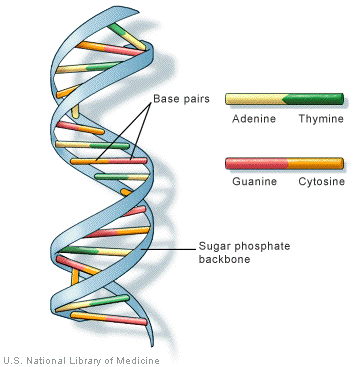
One of the research team described the double helix (DNA) as a visual metaphor for journeying and going on a shared journey.
Doing a quick search on the web for 'journeying' has resulted in books, blogs, websites and news that centres on spirituality and spiritual journeying. There's an obvious connection with spirituality and undertaking a journey of the Self based on belief, healing and wellness. It is deeply reflective and personal, but also engages the individual with community in the sense of pilgrim, travel and arrival. There's a sense of adventure and pushing the boundaries whether physical or personal/spiritual - traveling across landscapes and time and space.
There's also some scholarly work on the research journey, in particular participatory action research. For example, the opening lines of this particular article about PAR by Carol Stuart (1998) read as follows:
This paper explores the ethical dilemmas involved in Participatory Action Research (PAR), an adventurous research process that creates meaningful change in the lives of those who are engaged in the research.
Closely related to journeying I think is storytelling. The telling of the journey, or indeed within the journey itself. The oral record of travel, of landscape and a point or points in time. A recognition of relationship to place and others through an emotional expression artfully told. An acknowledgement of our connection to others and to place, inextricably linked by the journeying experience; a shared learning and living.
Robert Frost said it best:
The Road Not Taken
Two roads diverged in a yellow wood,
And sorry I could not travel both
And be one traveler, long I stood
And looked down one as far as I could
To where it bent in the undergrowth;
Then took the other, as just as fair,
And having perhaps the better claim,
Because it was grassy and wanted wear;
Though as for that the passing there
Had worn them really about the same,
And both that morning equally lay
In leaves no step had trodden black.
Oh, I kept the first for another day!
Yet knowing how way leads on to way,
I doubted if I should ever come back.
I shall be telling this with a sigh
Somewhere ages and ages hence:
Two roads diverged in a wood, and I--
I took the one less traveled by,
And that has made all the difference.

I'll leave this with you - a beautiful example of the story of the spiritual journey!
The storm approached – and I approached the storm; we were destined to meet, when all of a sudden I became aware of a lifting of the dark clouds and a lightening of the far horizon. Amazingly the rain and wind’s path changed direction a little to the north and was moving past me, not towards me any more. At that point my own path into the wind was able to change and with the threat now past I could turn away from the sea and back into the sand-dunes. Here I raised the woollen muffler from my ears and as I did so a sound pulled my attention back to the shoreline; my Oystercatcher, my constant Companion, gave a shrill cry and flew away northwards out of sight.
Leave
Leave by  ·BigGolf·

Saturday, 5 May 2012

Once upon a story: Storytelling, analogies and metaphors

There are many cultures on earth, each with rich traditions, customs and opportunities for storytelling. All these forms of storytelling are valuable. All are equal citizens in the diverse world of storytelling (National Storytelling Network).
It has occurred to me for some time now that stories are powerful tools to convey that which is often hard to describe, explain, or sell.
COOL STORY BRO !
Photo by M O O M O O !
Along with stories, metaphors and analogies are equally powerful tools and the three often work together. As we draw ever closer to an ideal mental health service model, I wonder how we can best convey, indeed pitch, the model to the project stakeholders.
Story as vision
Stories connect people to other people and to place, to the land and sea. Like the songlines of the Aborigines, stories map a place in a way beyond symbols and geography (Scott Edward Anderson).
How do we ensure the story holds up? Is the use of metaphor adequate? How do you keep the primary message clear? And what of multiple metaphors and analogies to tell the same story? We also need to come to some consensus on the shared story.
The model we are developing is taking shape much like an organism you could say, something that sits in cupped hands, lovingly held, like a flower unfolding. The layered petals add depth both to the metaphor and to the model - and so the analogy builds.
Story as explanation
When people hear stories about people they can identify with, the people in the stories become role models and their peers are encouraged to behave the same way. Such stories tend to be repeated and their lessons are spread (Kim Harrison).
What does it take to tell a great story? I came across this essay, The Healing Potential of Metaphor in the Narrative (2001), when searching for relevant mental health projects. The metaphor of water is used here in the "tidal model", an analogy of the ocean and one sailing on a wellness journey. When confronted by pirates (i.e. a health crisis) one must find a way to recover...and so on it goes. Reading about this model got me thinking not only about the power of narrative approaches, but how one must commit entirely to such a process - there's nothing more distracting and drab as a half-baked story!
Story as process
The most popular functional areas in which storytelling was used were envisioning and  goalsetting, reframing a situation and building self esteem. A smaller number [of coaches] said that they used stories to help with such issues as problem solving, empowerment and achieving success. (Margaret Parkin).
How might story be best used in our research project? Stories can explain, captivate, mobilise and remind. What would our (research) story achieve for us? At this point it would necessarily explain and perhaps more importantly mobilise people into action to bring about much needed change in the provision of mental health services (particularly to Aboriginal people).
A whole range of stories would also help to support the model in explaining each of its components in relation to Aboriginal people and their experiences (good and bad) of mental health services. These types of stories are hard to ignore when they come from direct lived experience.
To date we have used story techniques in our group work, including the role play scenarios, in addition to "elevator stories" and yarning. All have produced tangible outcomes and promoted deep thinking. And, as we draw nearer to an outcome, story may serve us well as part of our consensus and "sign off" process.

Friday, 6 April 2012

Mapping contexts, mapping meanings

"Tools" for today's session!Image: margoc
In our previous sessions the role play process has served us very well. In our last session we moved away from role plays and went with a 3D mapping activity. What's this I hear you ask? It's basically a technique that sees participants map out their thinking using 3D objects and paraphernalia. I used a similar technique in a futures thinking workshop some time ago.
landscaping02Image: margoc, 2005.
Just as role plays seem to "unlock" areas of the brain to respond in different and varied ways (as opposed to left brain rational thinking), so to 3D mapping gets the right brain working - our visual, creative side.
"The great pleasure and feeling in my right brain is more than my left brain can find the words to tell you." — Nobel Laureate Roger Sperry.
Our bodies often carry out actions and hold feelings and intuition in ways words cannot describe. Are you the type of person who cleans out your oven when you have something on your mind? I know I am! Our bodies "just know".
The session was hard work for all. I'm not sure we could have covered the territory we did in another way without taking a considerable amount of time, something we just do not have unfortunately. I took along some blocks and others made the most of objects around them. Some built a service model while others "performed" in their 3D context with much feeling. What a dynamic space it was! As with role plays, it takes a good deal of trust to expose oneself to this level of engagement and I'm so grateful that participants trusted the process we had invited them to engage in.
I came across some projects where 3D mapping was used to engage communities to define problems in their environment and develop community-based solutions. The Gaia Foundation is one such organisation who is working with communities using a participative 3D mapping (P3DM) process, and with multi-faceted and transformative outcomes.
The making of the 3D map is all part of a vital process of oral storytelling around the history and meanings of the landscape. It is through these stories that indigenous knowledge - often almost completely lost or forgotten - is given space to re-emerge. The knowledge and memory of the Elders suddenly becomes critical to the process, thus validating it's worth in the eyes of the young whilst reinvigorating confidence in the Elders. The whole journey is a unifying participatory experience for the community; everyone is at the table, every voice is heard and decisions are made together (Gaia Foundation, 2010).


3D mapping can help to expose the many layers within an issue, or "wicked problem", which, when told through story, provides immediate connection, relevance and intrinsic value. Story, action and engagement are powerful tools critical to bringing about change.
When asked to feedback about the participatory mapping process in the abovementioned Ethiopian project, one villager wrote this:
“The P3DM process enables the community to look at itself using the model as a mirror” [my emphasis].
It seems that reflection is also critical to the process of change. One sees the landscape through an alternate lens and in a way that is possibly less threatening than real life where community and cultural roles, conventions and politics can crowd out more reflective processes.

Further reading
Rambaldi, G., Muchemi, J., Crawhall, N. & L. Monaci, (2007) Through the Eyes of Hunter-gatherers: Participatory 3D Modelling among Ogiek Indigenous Peoples in Kenya, Information Development, Vol. 23, Nos 2/3, 113-128.
Stefano di Gessa (2008) Participatory Mapping as a Tool for Empowerment: Experiences and Lessons Learned from the ILC Network. Report, International Land Coalition, March 2008.
Jon Corbett, et al. (2010) Participatory mapping and communication: A guide to developing a participatory communication strategy to support participatory mapping, International Fund for Agricultural Development (IFAD).

Friday, 9 March 2012

Building scenarios using participative methods

There is no happiness if the things we believe in are different than the things we do. -- Albert Camus, Philosopher, Writer (in Reed & Kolibar 1995).

analyzing mirror self-recognition
In a previous post I mentioned our use of recorded role play scenarios in our group sessions. Here I'll elaborate on our role play process and reflect on its effectiveness in our project so far.
Firstly, a brief background on role play scenarios. Role plays have been used as a group facilitation method across a range of contexts for some decades. Role plays have been utilised in education, therapy (e.g. psychodrama and sociodrama), business and leadership, community development, even computer based role-playing and simulation games and various other spaces where reflection and discussion take place for the purpose of learning, development and transformation.
Our first role play scenario displayed what a mental health service should NOT do when dealing with a client (in this case in a phonecall). Participants are all too familiar with this scenario!
Our second role play scenario displayed what a service MUST do when supporting a client (again in a phonecall). The role play scene was refined to capture the "first point of contact" between the service and the (potential) client.
To attempt a definition, a role play is
a staged and emotive encounter which delves into issues and problems people experience in their lives (or the lives of others). Role plays offer participants an opportunity to reflect on complex situations with multi-layered meanings, factors and issues. They enable a group to "spotlight" these complexities so as to make them more accessible in order to address them.
In our case, and particularly with the second role play we held in our last group session, we invited the group members to be "directors" of the role play; that is, offering suggestions to the actors on how they might improve the scene and thus display the "ideal service" they could hope for. This meant stopping and starting the scene to incorporate the suggestions as discussed by the group. Some of these discussions were wide ranging, vigorous and emotive.
Reed and Kolibar (1995) present a similar technique but go a step further to suggest a participant tap the actor on the shoulder and step into the scene, replacing the actor from that point, acting out what they think should occur in the scene. This reflective technique, while emotional charged, is also a way to draw on people's ability to connect with issues and commit to - indeed invest in - seeking solutions to them.
Did the process work for us? Yes, I think it did. With more than an hour of discussion, we ended up with about 7 minutes of unedited, cut together footage, but the real outcome was the way the group moved to resolve some of the key element they saw were necessary for a relevant, high quality mental health service. The role play technique certainly supports the participatory process we've undertaken to use in the project, as this quote from Reed and Kolibar (1995) demonstrates:
Participants are challenged to develop potential solutions to the identified problem and then try out their comfort level in implementing the solution. In the process participants can realize the strengths and weaknesses of the proposed solutions, and may discover new facets of the problem. [my emphasis]
Could we have achieved this in other ways? Most probably, but I would argue that we may not have done so as quickly! The level of commitment of the group members was highly apparent. And, as one member stated, this process (of using role plays) was real and authentic! So too, as a facilitator in this process, I was mindful of the vulnerability of the actors as much as of the group members. It is necessary to ensure the space remains a safe one in which all can explore and confront the issues at hand, in ways that best suit them. To juggle such interactions is tricky and group protocols are necessary to have in place beforehand, so all can respect the space and its purpose ahead of such emotive interactions.
Such is the emergent and liminal nature of participatory action research!


Thursday, 23 February 2012

Transformative development


P212

We had our third planning meeting yesterday which was really energising - what a talented bunch I'm working with. :o)
As part of our facilitation, we've begun using video scenarios to delve deeper into the elements discussed by the group with some promising outcomes. Using this approach seems to move people away from their recognized positions and experiences to a place where they are almost bodily present; experiencing the moment in the scenario itself. This seems to release them of their "duty", perhaps, to their everyday roles and baggage.
It certainly resulted in a very energized group discussion within which I felt I also experienced - and witnessed - yarning (see Bessarab & Ng'andu 2010). The conversation was like a dinner conversation, was how one participant put it.
With regard to the scenario itself, we opted to display "how not to do things", so in our next session we will focus on "how things could be done" to achieve better outcomes.
And on a reflective note, this image is one that sparked a mini epiphany for me, as following our last session, I've felt in a bit of a wallow - not sure why, but mentioned this to the team during our planning and was provided with the following advice:
"Revisit the haze and stay with the question."
Really, this is the essence of PAR in process! The image marks a turning point in my thinking about transformative processes which can enable real change and encourages - no, insists upon - an active and authentic partnership between service providers and the people they serve in our communities.
Now to hold this space and remain present with the group as they - we - continue to develop and explore.

Thursday, 26 January 2012

Action inquiry resources

We had our first Project Community Steering Group meeting yesterday which really got my senses going (I don't know how else to put it; it was quite an emotional event for me and I was quite nervous leading up to it for a range of reasons). I'm really warming into this!
I'm collecting web resources about activist learning and development here on Delicious. I'd love to hear of sites you've used or seen that would be helpful too!
One article I've just read titled "Lucienne Roberts: A is for Activism" (2011) is a commentary by Roberts on the idea of design activism. She reflects on her work as a graphic designer and whether or not she sees herself contributing to activist movements and the social good.
George Bush Shoulda billboard alteration
Image : Steve Rhodes (flickr)
I'm sensing that given the participatory nature of the Project, it seems logical to develop an activist education design approach in service to the participants. Not only logical, but it FEELS right. I'm seeing many connections between 'good' education design and participatory action research both in shared principles and similar practices.
Briefly, shared principles might include:
  • user participation and centredness
  • collaborative design and development
  • transformation and change
  • emergent design (i.e. research design and ed design framework)
  • critical reflection
  • activism
  • action inquiry
Some similar practices might include:
  • ongoing consultation and feedback (dialogical)
  • workshopping design elements using group processes
  • developing mini scenarios and case studies
  • (meta) reflection on the process(es)
  • telling stories and active listening
  • ensuring safe spaces to work together
I'm sure I'll be delving into these points and more as my involvement in the project grows!