Showing posts with label vulnerability. Show all posts

Sunday, 16 November 2014

Relationships: the glue when all else crumbles

I'm attempting to bring together some thoughts on relationship as we work on a booklet (a sort of preparatory guide) which will capture how we see the service providers working together with Nyoongar Elders in our project, the Looking Forward Project. We developed a Handbook in 2013 to help prepare service providers to come into the project and think about what they needed to consider to begin their work with the Nyoongar community. Already we are seeing some activities between stakeholders provide some spaces for conversation and learning, based on the relationships that are bieng formed and deepened!

The booklet will extend our thinking and insights into how people with differing worldviews can effectively work together.

So, these are some first thoughts to get some things down in writing, which is a challenge when so much of this work is deeply experiential!

To be in relationship is to connect, to join together, to get in touch with, or establish rapport (cf. etymology of connect). We can relate a story, or associate with, or relate to others.

Some initial questions:
  • Relationships are key to our work - why?
  • What kind of relationships do we mean?
  • Why are they so important and necessary?
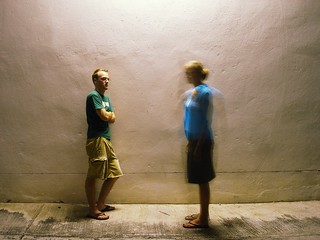
Relationships keep us connected and alive. They bind us to those we know and those we trust in such vulnerable circumstances. They are what keep us grounded when all else crumbles around us. They also enable us to meet new people and try new experiences so we continue to grow and deepen our human capacities. So, in terms of the project, people can trust others more when they know each other better. They care for each other, so remain conscious of one another when in conversation or action together. People are more likely to remain open to new experiences, challenging ideas and different ways of being, working and thinking.

Image by Michael Sarver on Flickr.
Holding is relationship. Being held by others and holding others is an incredible investment in trust and respect, an almost sacred act. There is a deep sense of care and concern for oneself as well as for others. it takes time to not only make such a connection, but to make a commitment to doing so in the first place. We need to understand our own motivations and intentions in order to commit fully. No one can talk us into it, it comes from us alone. I'm reminded here of a quote by James Marcum (2001) from our Handbook about engagement, which points to an intrinsic willingness to connect with others:
Engagement is a “bottom up,” grassroots process that cannot be directed from above. Engagement occurs when [people] undertake tasks related to their interests and competence, learn about them continuously, participate freely with (equal) associates, immerse themselves deeply, and continue the task with persistence and commitment because of the value they attribute to the work.
Relationships - what do they look like? They are dynamic, oscillating, complex, light and shade, generative and integral to our human existence. They include values and beliefs, actions and behaviours, practices and habits, past and present, memories and moments. They require talking, touching, teaching, learning, time, frequency, preparation, mindfulness, reflection, vulnerability, honesty, trust, respect, authenticity, reciprocity and generosity. They require our whole being, and we require whole relationships to truly be the best versions of ourselves that we can be. I like Moustakas's thinking on relationships in terms of "being with," together...

Moustakas, Being-In, Being-For, Being-With (1995, p. 70, 71):

In the authentic relationship, there is a facing up to the feelings and issues, an exercise of wills, without the will on either side being negated, impaired, or broken. The will ignites the fires of determination and enables one to face the old patterns of criticism, adversity, and rejection; enables one to live with the negative feelings and thoughts while creating new images and meanings in the process.
And finally why is this all necessary? We have realised, through our project, that for people to manage the unsettled nature of the work they are doing, the relationships they develop help to provide a sort of human glue. Our project is a decolonizing one. It asks people to question their very foundations - the worldviews they hold and the values it supports. This is disruptive, destablising and disconcerting. Relating to others in this contested space enables people to feel safe during such struggle and each feels care and concern for the other.

Conversation is relationship. How we relate to each other occurs through our language and communication (verbal, body, explicit, implicit, coded, power-laden, and so on). A space in which to converse is potentially a decolonizing space - a contested space. It is a space that enables many different views to be shared without persecution and where each voice is respected in the representation of the speaker's worldview. It's not easy to maintain such a space but is necessary if decolonizing is to occur. Interestingly, the etymology of "contested" is, "to bear witness together" - I love it! :o)...

Decolonizing work - looks like undoing structures, breaking current habits and pausing current actions and processes - destabilising, ground moves from under us, we can no longer rely on what we know and think of as 'truth' and so feel displaced and uncertain. I'm reminded of Iseke's work with Canadian Elders when thinking about how this work can decolonize, through the very presence of the Elders and their spiritual rites, rituals and knowledge.

More thoughts to come, and though this may not be well structured as yet, I'm feeling the urge to write otherwise it's difficult to get the words out at all!

Tuesday, 7 February 2012

In reading mode . . .

It's tricky to post whilst caught in a heap of reading and process - it is a liminal place to be really! Until there's a "pit stop" or the journey reaches some sort of conclusion or pause, it's not always apparent to write one's thinking until one has thought it out some more :o)
So, here's what I'm reading / watching:
1. Bessarab & Ng'andu (2010) Yarning about yarning as a legitimate method in Indigenous research, International Journal of Critical Indigenous Studies, Vol 3, No 1, 37-50.
Why? The research team has been discussing the idea of yarning and whether or not it should be a specifically articulated practice engaged with in the Community Steering Group sessions. More and more yarning is seen as a legitimate and rigourous data gathering method and implies a connection between researcher and participants, where both acknowledge a transformation can occur in each other. In prticualr, and as I'm just reading now, Bessarab and Ng'andu discuss collaborative yarning, one of four forms of yarning a researcher should be cognisant of when undertaking research wth Indigenous peoples. As we conclude our reading of this text, the team will come together to share our reflections and see whether or not we move forward with this method in some way (of course, then discussing it with the group participants).
2. Brene Brown, The Power of Vulnerability (TEDx Houston June 2010).
Why? I'm exploring and reflecting on the role of researcher especially from a PAR perspective. The notion of engaging the whole self in the research is powerful for me and I expect to be transformed by this experience. I'm also highly aware of my white fella role and baggage I bring with me, at the same time, I must own this rather than dismiss it, as it informs who I am and how I be. Brown's talk lends some further words and thinking around this.
http://video.ted.com/assets/player/swf/EmbedPlayer.swf
3. Closing the Gap Clearinghouse - Council of Australian Governments (COAG)
Why? Sifting through a range of published articles, reports and project websites that seek to address Indigenous disadvantage in Australia and include health and wellbeing in particular, provides me with the landscape in which our project operates (at least theoretically for the most part). Some articles I've sourced so far include:
There's more, but this is the stuff I'm most involved with right now. And, as Brene Brown says in the intro to her talk:
Lean into the discomfort of the work.
More reflections to follow!