 |
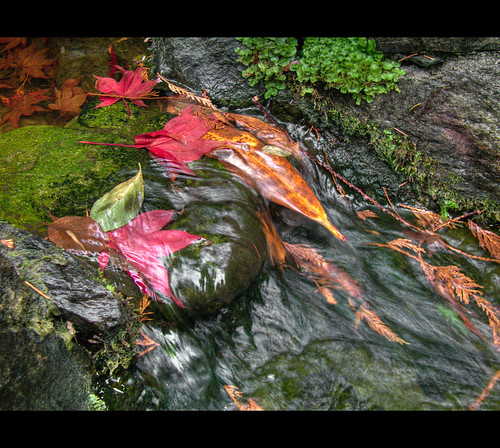
| Time flows on... Evan Leeson (Flickr) |
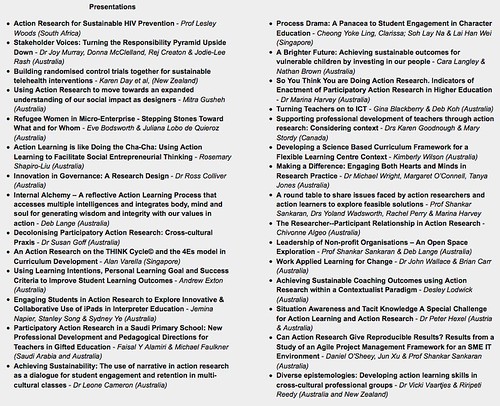
This whole train of experiencing, and the meanings that I have thus far discovered in it, seem to have launched me on a process which is both fascinating and at times a little frightening. It seems to mean letting my experiences carry me on, in a direction which appears to be forward, toward goals that I can but dimly define, as I try to understand at least the current meaning of that experience. The sensation is that of floating with a complex stream of experience, with the fascinating possibility of trying to comprehend its ever-changing complexity. --Carl Rogers, 1952I like this note from Rogers' essay. For me, it goes to the heart of what we experience and how we learn through our experiences (given experiential learning theories are most often based on Rogers' work). It also reminds me of one of the presentations from the ALARA conference held in Sydney last week, where Joy Murray, one of the presenters, talked about her use of Cybernetics to best describe her own experiences in the world. She made the point that we knit our use of theories and research to our direct lived experiences as a way to help us explain, or give some language to what we experience and how we make meaning of those experiences. We can only ever really account for our own experiences, others account for their own, in their own way, as they need to.
Joy was co-presenting with three community members with whom she had been working to develop a leadership program that was built on community needs and driven by community wishes (i.e. a community steering group was set up to "manage" the program itself). The project was a great example of supporting emergent community needs, developing empowered people and addressing issues at the local level.
As I've worked on this Aboriginal mental health service provision project over the last 8 months, I've come to focus more and more on my personal journey as a "researcher". I remember saying early on in the year (e.g. Brown's TED talk resonated strongly with me) that I expected to be changed in some way by working on the project. And as Rogers says, realising the "sensation ... of floating with a complex stream of experience, with the fascinating possibility of trying to comprehend its ever-changing complexity"!
We cannot ignore our experiences, most especially when we "research". Dave Hiles begins his 2001 essay, "Heuristic Inquiry and Transpersonal Research", with a quote from Braud and Anderson (1998, p.3):
Many of the most significant and exciting life events and extraordinary experiences - moments of clarity, illumination, and healing - have been systematically excluded from conventional research.I have heard it said that to do research that is sustainable and transformative, the research must "own us". Bruce Douglass & Clark Moustakas (1985) call heuristic inquiry "the internal search to know".
And so I enter - more knowingly than ever before - a journey of heuristic inquiry.
Further reading
Smith, MK (1997, 2004) 'Carl Rogers and informal education', the encyclopaedia of informal education. [www.infed.org/thinkers/et-rogers.htm. Last update: May 29, 2012]
Rogers, C & Freiberg, HJ (1993) Freedom to Learn (3rd edn.), New York: Merrill
Joy co-published a book with the abovementioned community members, which captures their own experiences of the community leadership project:
Murray J, Rash J-L, Creaton R, Cooley P and McClelland D (2009), Views from the inside: Participant Perspectives on Community Leadership. CommonGround Publishing Pty Ltd., Victoria.
More about the book:
In so doing the book explores the relationship between: one person's theory; a community development program in practice; and real life experience. It does this not through a voice of authority commenting on people's lived experience and attempting to relate this to the theory, but by showing what the program meant to the project leader and what it meant to each of the four participants. It tries to demonstrate, but not explain, how these disparate meanings connected, or otherwise, with the theory that the project leader believed she was applying; and how in the end all knowledge is personal, built up over a life time and stitched together with the threads of our relationships in whatever environment we happen to inhabit.Hiles, D (2001), Heuristic Inquiry and Transpersonal Research, paper presented to CCPE, London UK, October 2001. Available: http://psy.dmu.ac.uk/drhiles/HIpaper.htm
Braud, W & Anderson, R (Eds) (1998) Transpersonal Research Methods for the Social Sciences: Honoring human experience. Sage
Douglass, B & Moustakas, C (1985), Heuristic inquiry: the internal search to know, Journal of Humanistic Psychology, SUMMER 1985, vol. 25, no. 3, 39-55
Moustakas, C (1990) Heuristic Research: Design, methodology and applications. Sage