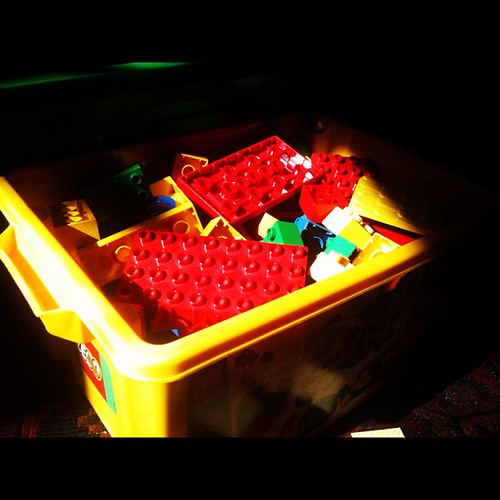
 Image: margoc
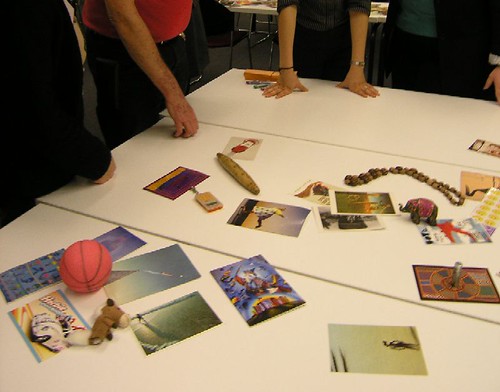 Image: margoc, 2005.
"The great pleasure and feeling in my right brain is more than my left brain can find the words to tell you." — Nobel Laureate Roger Sperry.Our bodies often carry out actions and hold feelings and intuition in ways words cannot describe. Are you the type of person who cleans out your oven when you have something on your mind? I know I am! Our bodies "just know".
The session was hard work for all. I'm not sure we could have covered the territory we did in another way without taking a considerable amount of time, something we just do not have unfortunately. I took along some blocks and others made the most of objects around them. Some built a service model while others "performed" in their 3D context with much feeling. What a dynamic space it was! As with role plays, it takes a good deal of trust to expose oneself to this level of engagement and I'm so grateful that participants trusted the process we had invited them to engage in.
I came across some projects where 3D mapping was used to engage communities to define problems in their environment and develop community-based solutions. The Gaia Foundation is one such organisation who is working with communities using a participative 3D mapping (P3DM) process, and with multi-faceted and transformative outcomes.
The making of the 3D map is all part of a vital process of oral storytelling around the history and meanings of the landscape. It is through these stories that indigenous knowledge - often almost completely lost or forgotten - is given space to re-emerge. The knowledge and memory of the Elders suddenly becomes critical to the process, thus validating it's worth in the eyes of the young whilst reinvigorating confidence in the Elders. The whole journey is a unifying participatory experience for the community; everyone is at the table, every voice is heard and decisions are made together (Gaia Foundation, 2010).

3D mapping can help to expose the many layers within an issue, or "wicked problem", which, when told through story, provides immediate connection, relevance and intrinsic value. Story, action and engagement are powerful tools critical to bringing about change.
When asked to feedback about the participatory mapping process in the abovementioned Ethiopian project, one villager wrote this:
“The P3DM process enables the community to look at itself using the model as a mirror” [my emphasis].
It seems that reflection is also critical to the process of change. One sees the landscape through an alternate lens and in a way that is possibly less threatening than real life where community and cultural roles, conventions and politics can crowd out more reflective processes.
Further reading
Rambaldi, G., Muchemi, J., Crawhall, N. & L. Monaci, (2007) Through the Eyes of Hunter-gatherers: Participatory 3D Modelling among Ogiek Indigenous Peoples in Kenya, Information Development, Vol. 23, Nos 2/3, 113-128.
Stefano di Gessa (2008) Participatory Mapping as a Tool for Empowerment: Experiences and Lessons Learned from the ILC Network. Report, International Land Coalition, March 2008.
Jon Corbett, et al. (2010) Participatory mapping and communication: A guide to developing a participatory communication strategy to support participatory mapping, International Fund for Agricultural Development (IFAD).
Stefano di Gessa (2008) Participatory Mapping as a Tool for Empowerment: Experiences and Lessons Learned from the ILC Network. Report, International Land Coalition, March 2008.
Jon Corbett, et al. (2010) Participatory mapping and communication: A guide to developing a participatory communication strategy to support participatory mapping, International Fund for Agricultural Development (IFAD).

