Showing posts with label storytelling. Show all posts

Monday, 25 June 2012

The story of journeying

We've been talking about journeying as we develop the Framework which is key to our project (especially over that past month). Certainly the Journey Towards Reconciliation has been discussed a number of times in our sessions. Check out some of the Reconciliation stories here (in particular, check out this one).
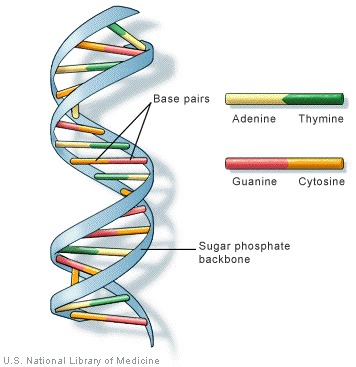
One of the research team described the double helix (DNA) as a visual metaphor for journeying and going on a shared journey.
Doing a quick search on the web for 'journeying' has resulted in books, blogs, websites and news that centres on spirituality and spiritual journeying. There's an obvious connection with spirituality and undertaking a journey of the Self based on belief, healing and wellness. It is deeply reflective and personal, but also engages the individual with community in the sense of pilgrim, travel and arrival. There's a sense of adventure and pushing the boundaries whether physical or personal/spiritual - traveling across landscapes and time and space.
There's also some scholarly work on the research journey, in particular participatory action research. For example, the opening lines of this particular article about PAR by Carol Stuart (1998) read as follows:
This paper explores the ethical dilemmas involved in Participatory Action Research (PAR), an adventurous research process that creates meaningful change in the lives of those who are engaged in the research.
Closely related to journeying I think is storytelling. The telling of the journey, or indeed within the journey itself. The oral record of travel, of landscape and a point or points in time. A recognition of relationship to place and others through an emotional expression artfully told. An acknowledgement of our connection to others and to place, inextricably linked by the journeying experience; a shared learning and living.
Robert Frost said it best:
The Road Not Taken
Two roads diverged in a yellow wood,
And sorry I could not travel both
And be one traveler, long I stood
And looked down one as far as I could
To where it bent in the undergrowth;
Then took the other, as just as fair,
And having perhaps the better claim,
Because it was grassy and wanted wear;
Though as for that the passing there
Had worn them really about the same,
And both that morning equally lay
In leaves no step had trodden black.
Oh, I kept the first for another day!
Yet knowing how way leads on to way,
I doubted if I should ever come back.
I shall be telling this with a sigh
Somewhere ages and ages hence:
Two roads diverged in a wood, and I--
I took the one less traveled by,
And that has made all the difference.

I'll leave this with you - a beautiful example of the story of the spiritual journey!

The storm approached – and I approached the storm; we were destined to meet, when all of a sudden I became aware of a lifting of the dark clouds and a lightening of the far horizon. Amazingly the rain and wind’s path changed direction a little to the north and was moving past me, not towards me any more. At that point my own path into the wind was able to change and with the threat now past I could turn away from the sea and back into the sand-dunes. Here I raised the woollen muffler from my ears and as I did so a sound pulled my attention back to the shoreline; my Oystercatcher, my constant Companion, gave a shrill cry and flew away northwards out of sight.
Leave
Leave by  ·BigGolf·

Saturday, 5 May 2012

Once upon a story: Storytelling, analogies and metaphors

There are many cultures on earth, each with rich traditions, customs and opportunities for storytelling. All these forms of storytelling are valuable. All are equal citizens in the diverse world of storytelling (National Storytelling Network).
It has occurred to me for some time now that stories are powerful tools to convey that which is often hard to describe, explain, or sell.
COOL STORY BRO !
Photo by M O O M O O !
Along with stories, metaphors and analogies are equally powerful tools and the three often work together. As we draw ever closer to an ideal mental health service model, I wonder how we can best convey, indeed pitch, the model to the project stakeholders.
Story as vision
Stories connect people to other people and to place, to the land and sea. Like the songlines of the Aborigines, stories map a place in a way beyond symbols and geography (Scott Edward Anderson).
How do we ensure the story holds up? Is the use of metaphor adequate? How do you keep the primary message clear? And what of multiple metaphors and analogies to tell the same story? We also need to come to some consensus on the shared story.
The model we are developing is taking shape much like an organism you could say, something that sits in cupped hands, lovingly held, like a flower unfolding. The layered petals add depth both to the metaphor and to the model - and so the analogy builds.
Story as explanation
When people hear stories about people they can identify with, the people in the stories become role models and their peers are encouraged to behave the same way. Such stories tend to be repeated and their lessons are spread (Kim Harrison).
What does it take to tell a great story? I came across this essay, The Healing Potential of Metaphor in the Narrative (2001), when searching for relevant mental health projects. The metaphor of water is used here in the "tidal model", an analogy of the ocean and one sailing on a wellness journey. When confronted by pirates (i.e. a health crisis) one must find a way to recover...and so on it goes. Reading about this model got me thinking not only about the power of narrative approaches, but how one must commit entirely to such a process - there's nothing more distracting and drab as a half-baked story!
Story as process
The most popular functional areas in which storytelling was used were envisioning and  goalsetting, reframing a situation and building self esteem. A smaller number [of coaches] said that they used stories to help with such issues as problem solving, empowerment and achieving success. (Margaret Parkin).
How might story be best used in our research project? Stories can explain, captivate, mobilise and remind. What would our (research) story achieve for us? At this point it would necessarily explain and perhaps more importantly mobilise people into action to bring about much needed change in the provision of mental health services (particularly to Aboriginal people).
A whole range of stories would also help to support the model in explaining each of its components in relation to Aboriginal people and their experiences (good and bad) of mental health services. These types of stories are hard to ignore when they come from direct lived experience.
To date we have used story techniques in our group work, including the role play scenarios, in addition to "elevator stories" and yarning. All have produced tangible outcomes and promoted deep thinking. And, as we draw nearer to an outcome, story may serve us well as part of our consensus and "sign off" process.

Friday, 6 April 2012

Mapping contexts, mapping meanings

"Tools" for today's session!Image: margoc
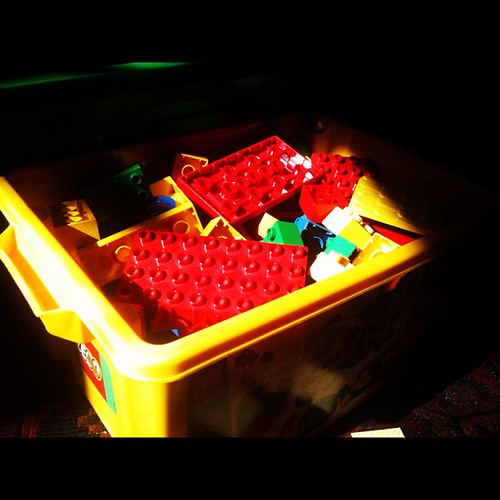
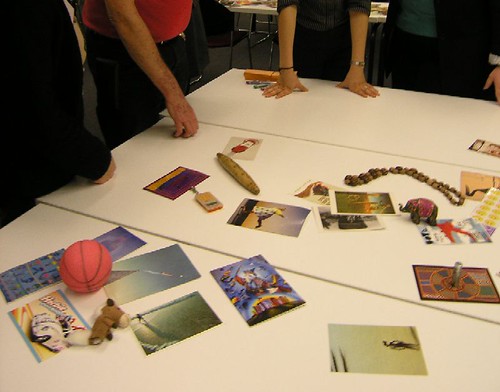
In our previous sessions the role play process has served us very well. In our last session we moved away from role plays and went with a 3D mapping activity. What's this I hear you ask? It's basically a technique that sees participants map out their thinking using 3D objects and paraphernalia. I used a similar technique in a futures thinking workshop some time ago.
landscaping02Image: margoc, 2005.
Just as role plays seem to "unlock" areas of the brain to respond in different and varied ways (as opposed to left brain rational thinking), so to 3D mapping gets the right brain working - our visual, creative side.
"The great pleasure and feeling in my right brain is more than my left brain can find the words to tell you." — Nobel Laureate Roger Sperry.
Our bodies often carry out actions and hold feelings and intuition in ways words cannot describe. Are you the type of person who cleans out your oven when you have something on your mind? I know I am! Our bodies "just know".
The session was hard work for all. I'm not sure we could have covered the territory we did in another way without taking a considerable amount of time, something we just do not have unfortunately. I took along some blocks and others made the most of objects around them. Some built a service model while others "performed" in their 3D context with much feeling. What a dynamic space it was! As with role plays, it takes a good deal of trust to expose oneself to this level of engagement and I'm so grateful that participants trusted the process we had invited them to engage in.
I came across some projects where 3D mapping was used to engage communities to define problems in their environment and develop community-based solutions. The Gaia Foundation is one such organisation who is working with communities using a participative 3D mapping (P3DM) process, and with multi-faceted and transformative outcomes.
The making of the 3D map is all part of a vital process of oral storytelling around the history and meanings of the landscape. It is through these stories that indigenous knowledge - often almost completely lost or forgotten - is given space to re-emerge. The knowledge and memory of the Elders suddenly becomes critical to the process, thus validating it's worth in the eyes of the young whilst reinvigorating confidence in the Elders. The whole journey is a unifying participatory experience for the community; everyone is at the table, every voice is heard and decisions are made together (Gaia Foundation, 2010).


3D mapping can help to expose the many layers within an issue, or "wicked problem", which, when told through story, provides immediate connection, relevance and intrinsic value. Story, action and engagement are powerful tools critical to bringing about change.
When asked to feedback about the participatory mapping process in the abovementioned Ethiopian project, one villager wrote this:
“The P3DM process enables the community to look at itself using the model as a mirror” [my emphasis].
It seems that reflection is also critical to the process of change. One sees the landscape through an alternate lens and in a way that is possibly less threatening than real life where community and cultural roles, conventions and politics can crowd out more reflective processes.

Further reading
Rambaldi, G., Muchemi, J., Crawhall, N. & L. Monaci, (2007) Through the Eyes of Hunter-gatherers: Participatory 3D Modelling among Ogiek Indigenous Peoples in Kenya, Information Development, Vol. 23, Nos 2/3, 113-128.
Stefano di Gessa (2008) Participatory Mapping as a Tool for Empowerment: Experiences and Lessons Learned from the ILC Network. Report, International Land Coalition, March 2008.
Jon Corbett, et al. (2010) Participatory mapping and communication: A guide to developing a participatory communication strategy to support participatory mapping, International Fund for Agricultural Development (IFAD).