Showing posts with label workshops. Show all posts

Friday, 6 April 2012

Mapping contexts, mapping meanings

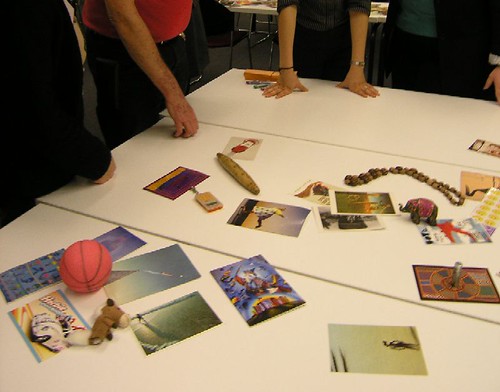
"Tools" for today's session!Image: margoc
In our previous sessions the role play process has served us very well. In our last session we moved away from role plays and went with a 3D mapping activity. What's this I hear you ask? It's basically a technique that sees participants map out their thinking using 3D objects and paraphernalia. I used a similar technique in a futures thinking workshop some time ago.
landscaping02Image: margoc, 2005.
Just as role plays seem to "unlock" areas of the brain to respond in different and varied ways (as opposed to left brain rational thinking), so to 3D mapping gets the right brain working - our visual, creative side.
"The great pleasure and feeling in my right brain is more than my left brain can find the words to tell you." — Nobel Laureate Roger Sperry.
Our bodies often carry out actions and hold feelings and intuition in ways words cannot describe. Are you the type of person who cleans out your oven when you have something on your mind? I know I am! Our bodies "just know".
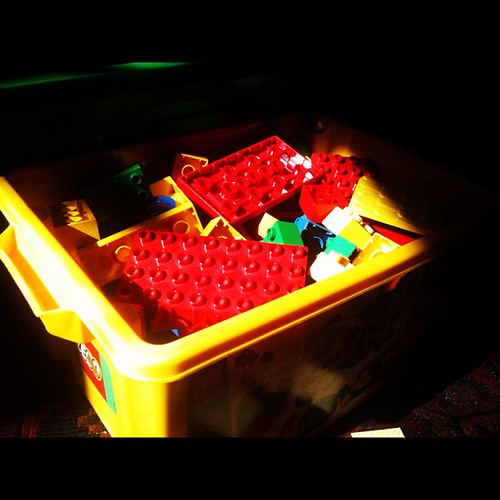
The session was hard work for all. I'm not sure we could have covered the territory we did in another way without taking a considerable amount of time, something we just do not have unfortunately. I took along some blocks and others made the most of objects around them. Some built a service model while others "performed" in their 3D context with much feeling. What a dynamic space it was! As with role plays, it takes a good deal of trust to expose oneself to this level of engagement and I'm so grateful that participants trusted the process we had invited them to engage in.
I came across some projects where 3D mapping was used to engage communities to define problems in their environment and develop community-based solutions. The Gaia Foundation is one such organisation who is working with communities using a participative 3D mapping (P3DM) process, and with multi-faceted and transformative outcomes.
The making of the 3D map is all part of a vital process of oral storytelling around the history and meanings of the landscape. It is through these stories that indigenous knowledge - often almost completely lost or forgotten - is given space to re-emerge. The knowledge and memory of the Elders suddenly becomes critical to the process, thus validating it's worth in the eyes of the young whilst reinvigorating confidence in the Elders. The whole journey is a unifying participatory experience for the community; everyone is at the table, every voice is heard and decisions are made together (Gaia Foundation, 2010).


3D mapping can help to expose the many layers within an issue, or "wicked problem", which, when told through story, provides immediate connection, relevance and intrinsic value. Story, action and engagement are powerful tools critical to bringing about change.
When asked to feedback about the participatory mapping process in the abovementioned Ethiopian project, one villager wrote this:
“The P3DM process enables the community to look at itself using the model as a mirror” [my emphasis].
It seems that reflection is also critical to the process of change. One sees the landscape through an alternate lens and in a way that is possibly less threatening than real life where community and cultural roles, conventions and politics can crowd out more reflective processes.

Further reading
Rambaldi, G., Muchemi, J., Crawhall, N. & L. Monaci, (2007) Through the Eyes of Hunter-gatherers: Participatory 3D Modelling among Ogiek Indigenous Peoples in Kenya, Information Development, Vol. 23, Nos 2/3, 113-128.
Stefano di Gessa (2008) Participatory Mapping as a Tool for Empowerment: Experiences and Lessons Learned from the ILC Network. Report, International Land Coalition, March 2008.
Jon Corbett, et al. (2010) Participatory mapping and communication: A guide to developing a participatory communication strategy to support participatory mapping, International Fund for Agricultural Development (IFAD).

Saturday, 10 March 2012

What role does the camera play?


P125

I've been sitting with the Magee article I posted last month and reflecting on why it grabbed me and have realized that this article, along with the video clip by CineMatic Orchestra in a later post, highlights the role the camera plays in our ability to ask questions.
Magee herself questions her position as a photographer, which in turn pushes her to take brave steps in her work, as does Vertov in his attempts to present "truthful cinema". In the edited clip, Vertov brings the camera (and cameraman) into the scenes which is a question in and of itself - what IS the camera? What is it doing? How does it relate? What does it achieve?
The inclusion of the camera in the scenes invites critique.
This also appears to have been the case when we recorded the role play scenarios in our sessions. The scenarios took on a different "edge" when the group understood the scenarios would be recorded. Perhaps something about the finality of a recording? The spotlight on those in the role play? The "here and now" captured for posterity?
I'm keen to see what the reactions are when the second, "group-directed" scenario is played back in our next session! Will people want to see it? Will previous discussions be reopened? Emotions rekindled? Memories rewound? New discoveries made, more questions asked?
What further purpose will our recorded scenarios have in our developmental process? I wonder!

Friday, 9 March 2012

Building scenarios using participative methods

There is no happiness if the things we believe in are different than the things we do. -- Albert Camus, Philosopher, Writer (in Reed & Kolibar 1995).

analyzing mirror self-recognition
In a previous post I mentioned our use of recorded role play scenarios in our group sessions. Here I'll elaborate on our role play process and reflect on its effectiveness in our project so far.
Firstly, a brief background on role play scenarios. Role plays have been used as a group facilitation method across a range of contexts for some decades. Role plays have been utilised in education, therapy (e.g. psychodrama and sociodrama), business and leadership, community development, even computer based role-playing and simulation games and various other spaces where reflection and discussion take place for the purpose of learning, development and transformation.
Our first role play scenario displayed what a mental health service should NOT do when dealing with a client (in this case in a phonecall). Participants are all too familiar with this scenario!
Our second role play scenario displayed what a service MUST do when supporting a client (again in a phonecall). The role play scene was refined to capture the "first point of contact" between the service and the (potential) client.
To attempt a definition, a role play is
a staged and emotive encounter which delves into issues and problems people experience in their lives (or the lives of others). Role plays offer participants an opportunity to reflect on complex situations with multi-layered meanings, factors and issues. They enable a group to "spotlight" these complexities so as to make them more accessible in order to address them.
In our case, and particularly with the second role play we held in our last group session, we invited the group members to be "directors" of the role play; that is, offering suggestions to the actors on how they might improve the scene and thus display the "ideal service" they could hope for. This meant stopping and starting the scene to incorporate the suggestions as discussed by the group. Some of these discussions were wide ranging, vigorous and emotive.
Reed and Kolibar (1995) present a similar technique but go a step further to suggest a participant tap the actor on the shoulder and step into the scene, replacing the actor from that point, acting out what they think should occur in the scene. This reflective technique, while emotional charged, is also a way to draw on people's ability to connect with issues and commit to - indeed invest in - seeking solutions to them.
Did the process work for us? Yes, I think it did. With more than an hour of discussion, we ended up with about 7 minutes of unedited, cut together footage, but the real outcome was the way the group moved to resolve some of the key element they saw were necessary for a relevant, high quality mental health service. The role play technique certainly supports the participatory process we've undertaken to use in the project, as this quote from Reed and Kolibar (1995) demonstrates:
Participants are challenged to develop potential solutions to the identified problem and then try out their comfort level in implementing the solution. In the process participants can realize the strengths and weaknesses of the proposed solutions, and may discover new facets of the problem. [my emphasis]
Could we have achieved this in other ways? Most probably, but I would argue that we may not have done so as quickly! The level of commitment of the group members was highly apparent. And, as one member stated, this process (of using role plays) was real and authentic! So too, as a facilitator in this process, I was mindful of the vulnerability of the actors as much as of the group members. It is necessary to ensure the space remains a safe one in which all can explore and confront the issues at hand, in ways that best suit them. To juggle such interactions is tricky and group protocols are necessary to have in place beforehand, so all can respect the space and its purpose ahead of such emotive interactions.
Such is the emergent and liminal nature of participatory action research!